Rehabilitation, Reintegration and the Public Work of Justice
Podcast: Play in new window | Download
Subscribe: Apple Podcasts | Spotify | Amazon Music | TuneIn | RSS
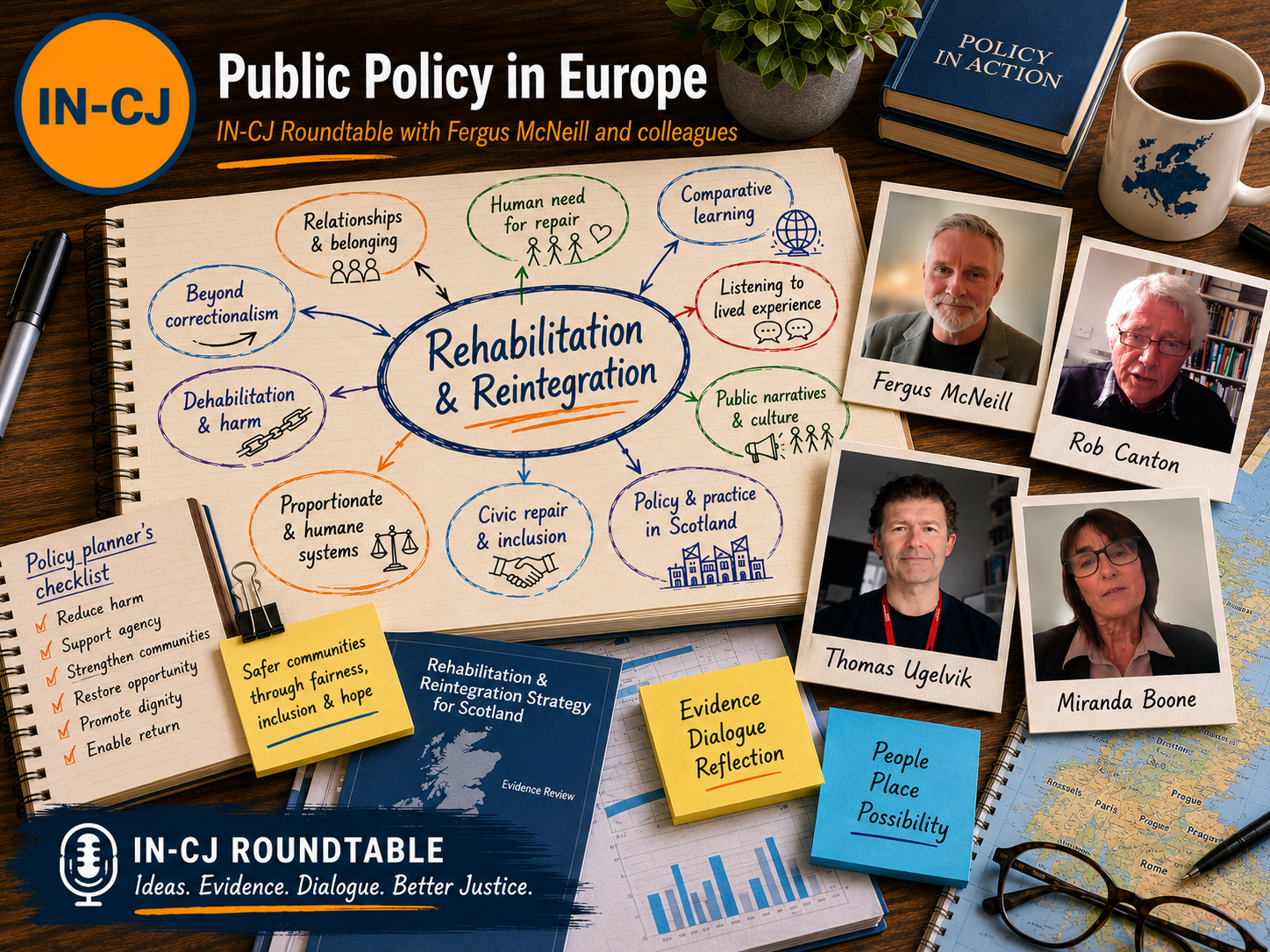
The IN-CJ roundtable with Professor Fergus McNeill, Professor Miranda Boone and colleagues returned to one of the most persistent questions in criminal justice: what do we mean when we talk about rehabilitation?
The discussion followed Professor McNeill’s earlier presentation on the Rehabilitation and Reintegration in Europe project, known as RaRiE. The roundtable broadened the conversation from the definition of rehabilitation to the practical, cultural and political conditions that make rehabilitation possible, or prevent it from becoming more than a managerial promise.
One of the important features of the discussion was that rehabilitation was not treated as a narrow technical intervention. It was not presented simply as a programme, a service pathway, a risk-management tool, or a correctional technique applied to an individual. Instead, the conversation repeatedly returned to rehabilitation as a wider social, legal, moral and civic question. If people are expected to return to society after punishment, then society, law, institutions and public services must also be examined. Reintegration cannot be placed only on the shoulders of the person who has offended.
Beyond Psychological Correctionalism
Rob Canton opened the discussion by noting that Professor McNeill’s earlier presentation had offered a broader and deeper conception of rehabilitation than the “psychological correctionalism” that often dominates criminal justice debates. This mattered throughout the roundtable. The discussion did not deny the importance of personal change, but it questioned whether personal change can be meaningful when the surrounding structures remain unchanged.
Professor McNeill described rehabilitation as a lifelong concern, rooted in questions of repair, return, recovery and re-entry. He also reflected critically on his own early practice experience, including the risk of doing harm in the name of doing good. This was not a peripheral observation. It pointed to one of the hardest lessons for policy and practice. Services can widen the net of control. They can increase the intensity of supervision. They can impose obligations that are administratively defensible but personally damaging. They can claim to support people while making ordinary social participation harder.
This has direct relevance for the public deployment of services. A rehabilitative service should not be judged only by whether it has a plausible theory of change, a defined referral route, or measurable outputs. It should also be judged by whether it reduces harm, respects proportionality, supports agency, and avoids turning support into an expanded form of punishment. In public service terms, rehabilitation needs a harm test as well as an effectiveness test.
Comparison As A Way Of Seeing
A second theme was the value of comparison. Miranda Boone described comparative work as a way of understanding one’s own system by encountering others. The point is not to engage in superficial policy borrowing. It is to see what one’s own system has normalised.
The Netherlands, Norway and Scotland were discussed as systems often understood as relatively progressive, but the roundtable made clear that none should be treated as a finished model. The Netherlands, Miranda Boone suggested, has seen a shift towards managerialism and responsibilisation. Scotland has a long rhetorical commitment to decarceration and rehabilitation, but that rhetoric may also become a form of national self-congratulation. Norway may have retained forms of penal humanity that other systems have lost, but even there the reintegration process after imprisonment remains insufficiently understood.
This comparative stance is valuable for policymakers because it moves the question beyond “which country has the best model?” A more useful question is: what cultural, legal, administrative and civic conditions allow rehabilitation to become real? Different jurisdictions may use similar language while producing very different effects. A service labelled as rehabilitative in one setting may support reintegration, while a similar service elsewhere may intensify control, stigma or exclusion.
For public deployment, this means that services cannot simply be copied from one jurisdiction to another. They must be adapted to the civic culture, institutional capacity, legal framework, public expectations and material conditions of the place in which they operate. Translation matters more than transfer.
Rehabilitation As Relationship Repair
One of the strongest moments in the roundtable came in response to a question about rehabilitation as a human need. Professor McNeill argued that human beings will always fail, cause harm and fall short of their own values. Unless relationships are simply abandoned after harm occurs, societies need mechanisms of repair.
This shifts rehabilitation from an individualised correctional task to a wider human and social problem. Criminal justice systems are only one way of responding to harm. In many parts of the world, communities develop their own forms of repair, restoration or retribution, sometimes with little reference to formal state institutions. The roundtable did not romanticise community justice, but it did challenge the assumption that state-led correctional systems are the only imaginable response.
For policy, this suggests that rehabilitation should not be designed solely as a criminal justice service. It has to connect with housing, employment, health, family relationships, civic participation, legal status and public recognition. A person cannot be meaningfully reintegrated into a community if the surrounding institutions continue to mark them as permanently outside it.
This is where the discussion has wider significance for public services. Rehabilitation is not a single service line. It is a coordination challenge across systems. It requires criminal justice, welfare, housing, health, education, community development and civic institutions to work with a shared understanding of return, repair and belonging.
The Problem Of Dehabilitation
The roundtable also raised the idea that criminal justice systems often create the very problems they later claim to solve. Professor McNeill used the term “dehabilitation” to describe what happens when people are pushed away into institutional settings, separated from ordinary life, relationships and responsibilities, and then expected to make the journey back.
This is particularly important for prisons. If imprisonment weakens family ties, disrupts housing, damages employment prospects, erodes health, reduces autonomy and deepens stigma, then rehabilitation after release is partly an attempt to repair harms produced by the system itself. The greater the distance a system creates between the person and ordinary civic life, the harder reintegration becomes.
For public deployment, this should alter how services are commissioned and evaluated. Reintegration services should not be treated as downstream fixes for upstream damage. Policymakers need to ask whether the overall design of punishment reduces or increases the distance people must travel to return. This includes sentence length, prison conditions, access to family contact, continuity of care, release planning, legal restrictions, disclosure rules, registration requirements and the availability of ordinary civic opportunities.
Listening To Lived Experience
A recurring theme was the importance of people with lived experience. Miranda Boone emphasised the value of conversations with experts by experience and expressed the hope that they would become structurally involved in decision-making about rehabilitation and reintegration.
This is not simply a matter of consultation. The roundtable pointed towards a more demanding model of dialogue. People subject to criminal justice systems should not be invited only to comment on services already designed by others. They should be part of the process of defining the problem, testing assumptions, identifying harms, and shaping what better practice might require.
This has clear implications for service deployment. A service that is designed without lived experience may appear coherent from an administrative perspective while failing in practice. It may underestimate stigma, fear, fatigue, shame, distrust, practical barriers, or the emotional cost of repeated institutional engagement. Lived experience can expose the difference between a service that exists on paper and a service that can actually be used.
For policymakers, the challenge is to move from episodic involvement to structural participation. That means building lived experience into governance, evaluation, commissioning, inspection, staff development and public accountability.
Culture, Narrative And Public Legitimacy
The discussion also made clear that rehabilitation is shaped by public culture. Tracey McFall raised questions about reframing public narratives and about the gendered dimensions of rehabilitation. Miranda Boone reflected on societal narratives and the different ways that Norway, the Netherlands and Scotland may frame humanity, responsibility and social care. Professor McNeill suggested that systems are shaped not only by evidence but by culture, identity, values and political possibility.
This is a critical point for public policy. Criminal justice systems rarely operate on evidence alone. They are also driven by public emotion, media narratives, political risk, institutional habit and moral assumptions about who deserves help. This means that better evidence, while necessary, is insufficient by itself.
If rehabilitation is to be publicly deployed with legitimacy, the public story must change. The question cannot be only “what works?” It must also be “what kind of society are we trying to sustain?” If punishment is framed primarily through exclusion and control, rehabilitative services will struggle to gain public permission. If rehabilitation is framed as repair, safety, belonging and civic renewal, a different policy space becomes possible.
This is why public engagement matters. Professor McNeill noted that the RaRiE project intends to include creative work and public exhibitions. Such work is not decorative. It is part of the democratic task of changing what can be imagined, discussed and authorised in public life.
Risk, Reform And The Status Quo
Simon’s contribution raised a practical challenge for criminal justice agencies: the status quo is often treated as safe, while change is treated as risky. Yet if current systems are not working well, maintaining them may itself be the greater risk.
This is highly relevant for public services. Innovation in criminal justice is often constrained by accountability structures that punish visible failure more readily than they recognise slow systemic harm. Agencies may inherit poor systems, but still carry responsibility for any attempt to change them. Research can then be experienced as external critique rather than as shared learning.
Professor McNeill’s response was to emphasise dialogue rather than linear knowledge transfer. Research should not pretend to discover answers which practitioners must then implement. Instead, policymakers, practitioners, researchers and people with lived experience need to move between proximity and distance: close enough to understand operational realities, distant enough to question inherited assumptions.
This suggests a different model of service development. Public deployment should be iterative, dialogical and reflective. It should create space for learning before implementation, during implementation and after implementation. It should not rely on fixed models rolled out at scale before their meaning, risks and lived effects are properly understood.
Difference, Stigma And Unequal Conditions Of Return
The roundtable also touched on the way rehabilitation differs by gender, offence type and legal status. The discussion of people convicted of sexual offences raised the significance of stigma, notification schemes, disclosure requirements and civic status. The closing comments also noted the often-neglected situation of people who commit offences outside their country of origin and may face transfer, removal or exclusion.
These questions matter because reintegration is not equally available to everyone. Some people return to communities that are prepared to receive them. Others return under conditions of intense suspicion, legal restriction, public hostility or administrative uncertainty. Some may not be able to return at all.
For policy, this means that rehabilitation cannot be designed around an abstract average service user. The conditions of return differ. A serious public deployment model must take account of sex, age, family status, nationality, immigration position, offence type, risk classification, disability, mental health, substance use, housing status and the presence or absence of community support. It must do so without reducing people to categories. The practical question is not only what service is offered, but what barriers stand between that person and a viable civic life.
From Service Delivery To Civic Repair
The roundtable’s wider significance lies in its challenge to a service-delivery mindset. Rehabilitation cannot be reduced to a sequence of interventions delivered to a managed individual. It is a public process of repair, recognition and reintegration. It requires services, but it cannot be contained by services.
For policymakers, this means that rehabilitation should be assessed across several domains. Does the system support personal change? Does it restore legal and civic status where appropriate? Does it address material needs such as housing and income? Does it reduce stigma? Does it support relationships? Does it create meaningful opportunities for belonging? Does it avoid unnecessary intrusion, surveillance and control?
For practitioners, the discussion affirms the importance of discretion, relationship and reflective judgement. For researchers, it reinforces the need for methods that are comparative, dialogical, creative and attentive to lived experience. For public bodies, it raises a more demanding test: whether rehabilitative claims are matched by institutional arrangements that make reintegration possible.
A Policy Agenda For Public Deployment
The practical lesson from the IN-CJ roundtable is that rehabilitative services should not be deployed as isolated programmes. They should be developed as part of a wider civic architecture of return. That architecture must include proportionate supervision, humane institutions, continuity of support, meaningful participation, public dialogue, material security, legal restoration and social recognition.
This does not make rehabilitation easy. The discussion repeatedly acknowledged complexity, contradiction and uncertainty. But it does make the policy challenge clearer. If rehabilitation is about repair, then the work belongs not only to criminal justice agencies, but to societies as a whole.
The RaRiE project is still at an early stage. Its importance lies partly in the answers it may eventually produce, but also in the quality of the questions it is already asking. What harms are caused in the name of help? What would it mean for a system to rehabilitate without expanding punishment? What can countries learn from one another without copying one another? How can lived experience become part of decision-making rather than a supplement to it? What public stories make repair possible?
These are not only academic questions. They are questions for anyone involved in designing, commissioning, delivering or evaluating public services. They ask whether rehabilitation can become more than a promise attached to punishment. They ask whether public systems can make return possible in practice, not only in principle.