Living Criminal Justice Research – Why Good Endings Matter
Podcast: Play in new window | Download
Subscribe: Apple Podcasts | Spotify | Amazon Music | TuneIn | RSS
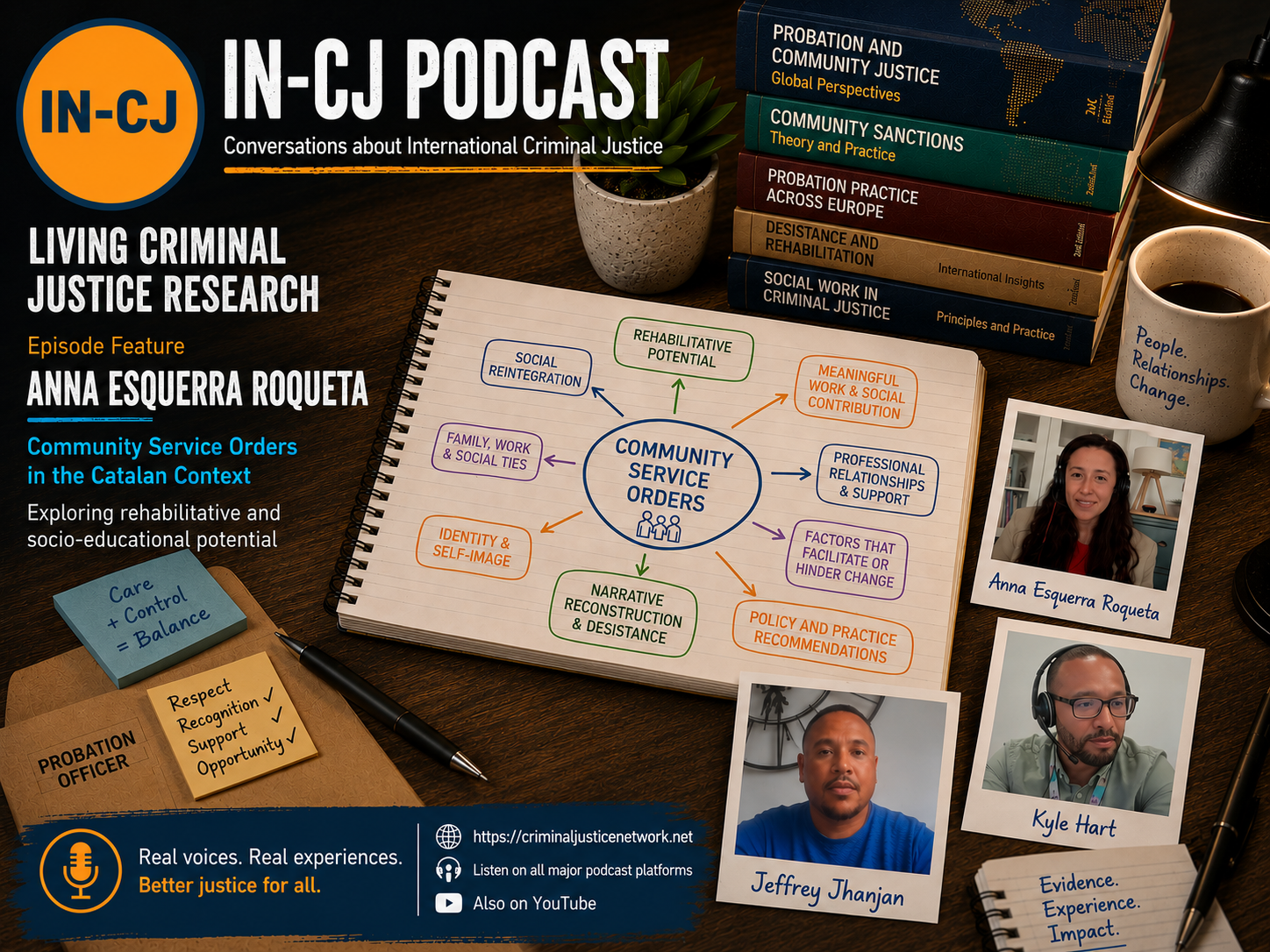
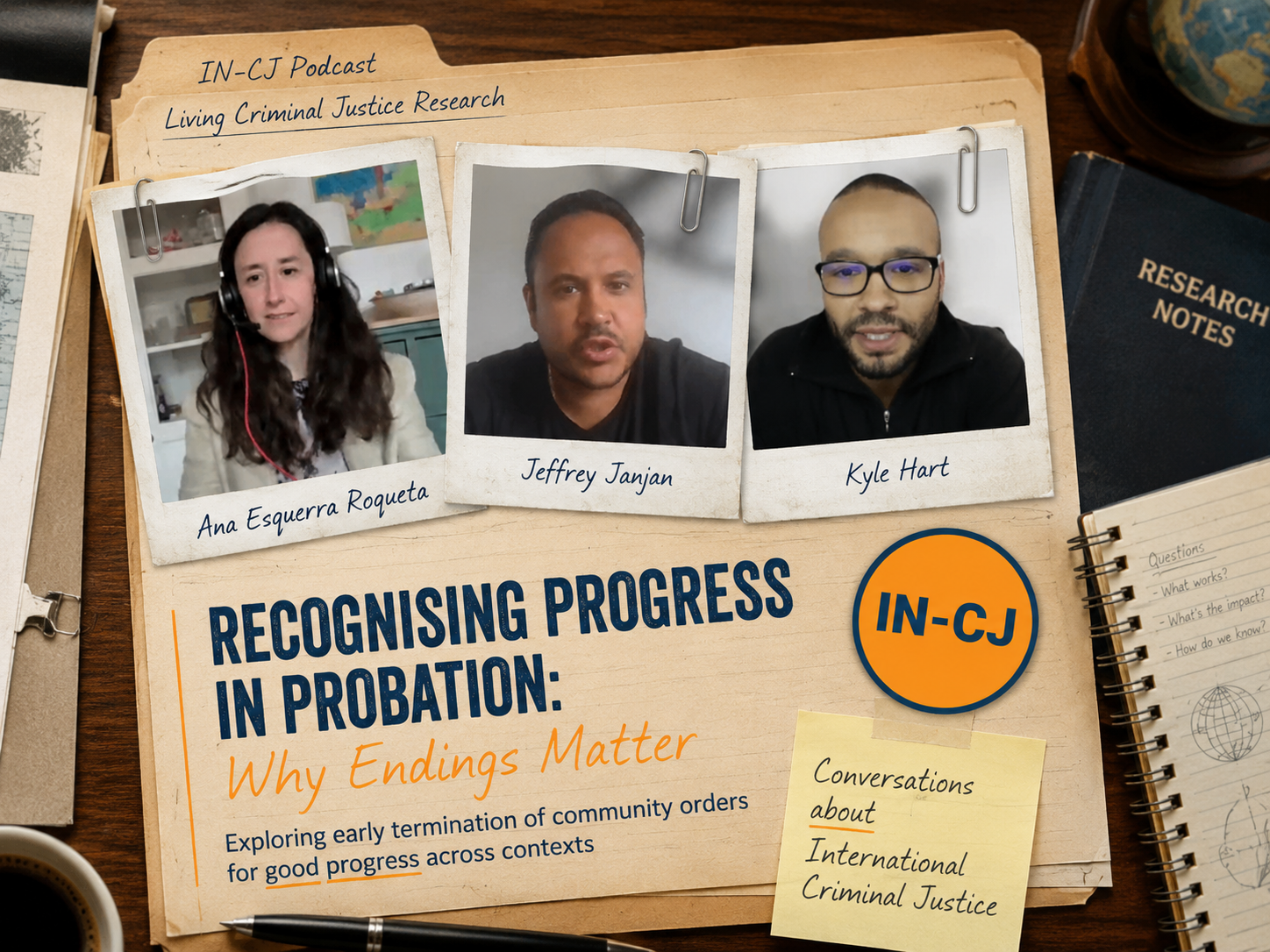
How should probation systems recognise meaningful progress? This is the central question explored in the first episode of IN-CJ’s Living Criminal Justice Research podcast, where Ana Esquerra Roqueta and Jeffrey Janjan speak with Kyle Hart about the early termination of community orders for good progress.
The conversation will be relevant to many people across the IN-CJ network: probation practitioners, criminal justice managers, researchers, academics, policy makers, students and advocates who are interested in how criminal justice systems can become more constructive, proportionate and evidence-informed. Although the discussion is grounded in practice in England and Wales, the issues it raises have clear international significance.
Ana Esquerra Roqueta, Policy and Liaison Officer at the Confederation of European Probation and Associate Teacher at the University of Barcelona, introduces the episode alongside Jeffrey Janjan, a policy adviser from the Netherlands and PhD candidate at Leiden University. Their guest, Kyle Hart, is a Senior Probation Officer with His Majesty’s Prison and Probation Service and a training lead in the West Midlands.
Kyle’s research was completed as part of the HMPPS Community and Criminal Justice Leadership Master’s Degree, concluded in February 2026. His dissertation examined early termination of community orders for good progress, a practice that is available within probation policy in England and Wales, but which appears to be used relatively rarely.
Resource List and Bibliography
Early termination for good progress refers to the ending of a community order before its planned completion date because the person on probation has achieved the aims of the sentence. It applies specifically to community orders, rather than post-custody licence arrangements. In simple terms, it asks whether supervision has done what it was intended to do. Has risk been reduced? Has the person engaged meaningfully? Has there been evidence of constructive change? If so, is continued supervision still necessary?
This is not a narrow procedural issue. It goes to the heart of what probation is for. Community supervision is expected to protect the public, support compliance, encourage rehabilitation and provide a proportionate response to offending. If those aims have been met, then there is a strong professional and ethical question about whether supervision should continue simply because the original end date has not yet arrived.
Kyle explains that probation practitioners have long had the power to return cases to court for early termination on the grounds of good progress. Yet his research suggests a clear gap between policy and practice. He notes that Ministry of Justice figures indicate that only a small minority of cases are terminated early on this basis. For a practice that could help to recognise rehabilitation, motivate engagement and strengthen confidence in community sentences, this is a striking finding.
The podcast explores why this happens. One important theme is the influence of risk culture. Public protection must remain central to probation work, but an organisational emphasis on defensibility can make practitioners cautious about recommending early termination, even where progress has been made. In some cases, continuing supervision may feel like the safer professional option. Yet this can also mean that positive change is not formally recognised, and that probation becomes better at recording risk than marking progress.
Operational pressure is another important factor. Delays in court processes, waiting lists for interventions, heavy workloads and limited service capacity can all make it harder to evidence progress within the available timescale. Kyle also discusses how some newer policies may reduce the amount of direct supervision time available, making it harder for practitioners to observe, assess and record meaningful change. A further barrier is awareness. If early termination for good progress is not consistently included in training or practice guidance, newer staff may simply not know that it is an option.
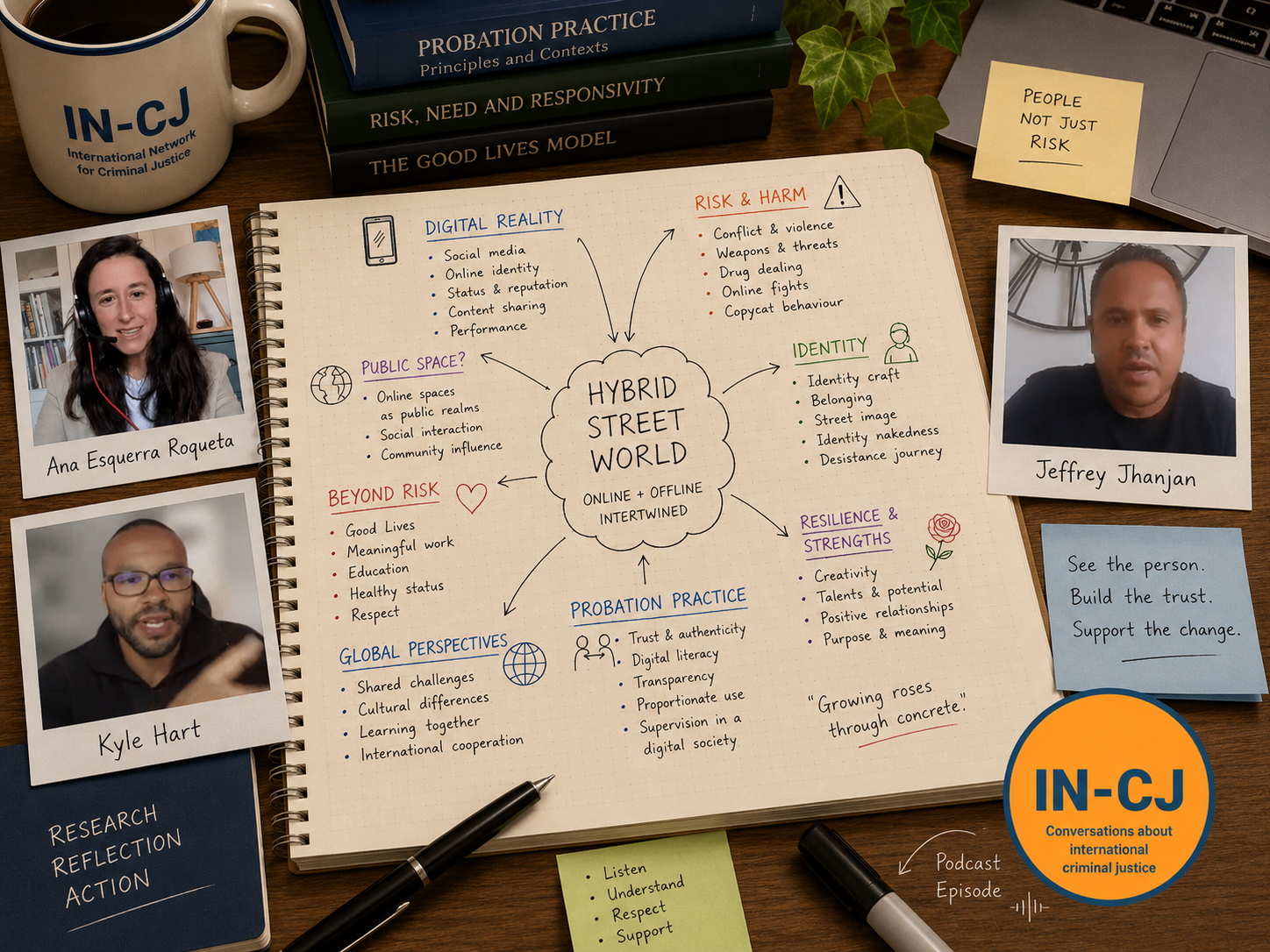
One of the most interesting parts of the conversation concerns desistance and identity. Ana draws attention to the relationship between recognition, self-confidence and the process of moving away from offending. This is where the discussion becomes especially valuable for an international audience. Criminal justice systems often have well-developed mechanisms for identifying breach, failure and risk escalation. They may have fewer clear rituals, processes or records that say: something has changed, progress has been made, and the person is no longer in the same position as when the sentence began.
Kyle links this to the importance of endings in probation. He reflects on earlier practice experience where completion ceremonies and certificates were used to recognise progress within rehabilitative programmes. These forms of recognition can matter. They can help people understand their own progress, build confidence and see themselves differently. They can also help practitioners, courts and communities recognise that rehabilitation is not an abstract concept, but something that can be observed, evidenced and acknowledged.
The episode is careful not to present early termination as a simple reward. Kyle makes an important distinction between reward and recognition. A community order is a sentence imposed in response to offending, and public confidence depends on the sentence having credibility and purpose. However, if the objectives of the sentence have been achieved, then early termination can be framed not as leniency, but as evidence that the sentence has worked. This distinction is vital. It allows early termination to be understood as a proportionate and outcome-focused decision, rather than as a soft option.
The international dimension of the discussion is particularly useful. Ana reflects that, in Catalonia, community work sentences are generally completed in full, with fewer formal opportunities for early termination based on progress. Jeffrey notes that the Netherlands has something comparable, but that it is also used sparingly, partly because risk thinking remains dominant. These comparisons show that the issue is not confined to one jurisdiction. Across different systems, practitioners and policy makers face similar questions about risk, rehabilitation, proportionality and public trust.
For researchers, the episode identifies an important area for further study. Kyle argues that more evidence is needed, including research with sentencers, victims, practitioners and people on probation. It would be useful to know more about how early termination affects engagement, compliance, identity change, employability, reoffending, public confidence and professional decision-making. It would also be valuable to compare how different jurisdictions recognise progress and bring supervision to an end.
For practitioners, the episode offers a practical challenge. How often do we actively review whether the purpose of a community order has been achieved? How confident are staff in identifying and evidencing good progress? What forms of recognition are available to people who have made real change? Are endings treated as part of the rehabilitative process, or merely as administrative closure?
For policy makers and system leaders, the conversation points to questions about training, guidance, data, court access and organisational culture. If early termination for good progress is lawful, legitimate and potentially useful, then systems need to make it visible and workable. Practitioners need clear criteria. Courts need confidence in the evidence presented. People on probation need to understand what progress looks like. Services need to be able to record and report outcomes, not only inputs and failures.
This first episode of Living Criminal Justice Research demonstrates the value of bringing practice research into international conversation. Kyle’s work begins with a specific feature of probation practice in England and Wales, but it opens up much wider questions. How do justice systems recognise success? How do they balance public protection with proportionality? How do they avoid extending intervention beyond what is necessary? How do they support people to move from supervised compliance into a more stable and self-directed life?
At its core, the episode is about endings. Not endings as paperwork, but endings as meaningful moments in the process of rehabilitation. A good ending can recognise progress, support desistance, strengthen professional confidence and show that community supervision has a clear purpose. For IN-CJ’s international audience, this discussion invites careful reflection on how probation and community justice systems can become more confident in recognising when change has happened, and when it is time to let the sentence end.