Living in Criminal Justice Research – Street Culture, Digital Identity and Probation Practice
Podcast: Play in new window | Download
Subscribe: Apple Podcasts | Spotify | Amazon Music | TuneIn | RSS
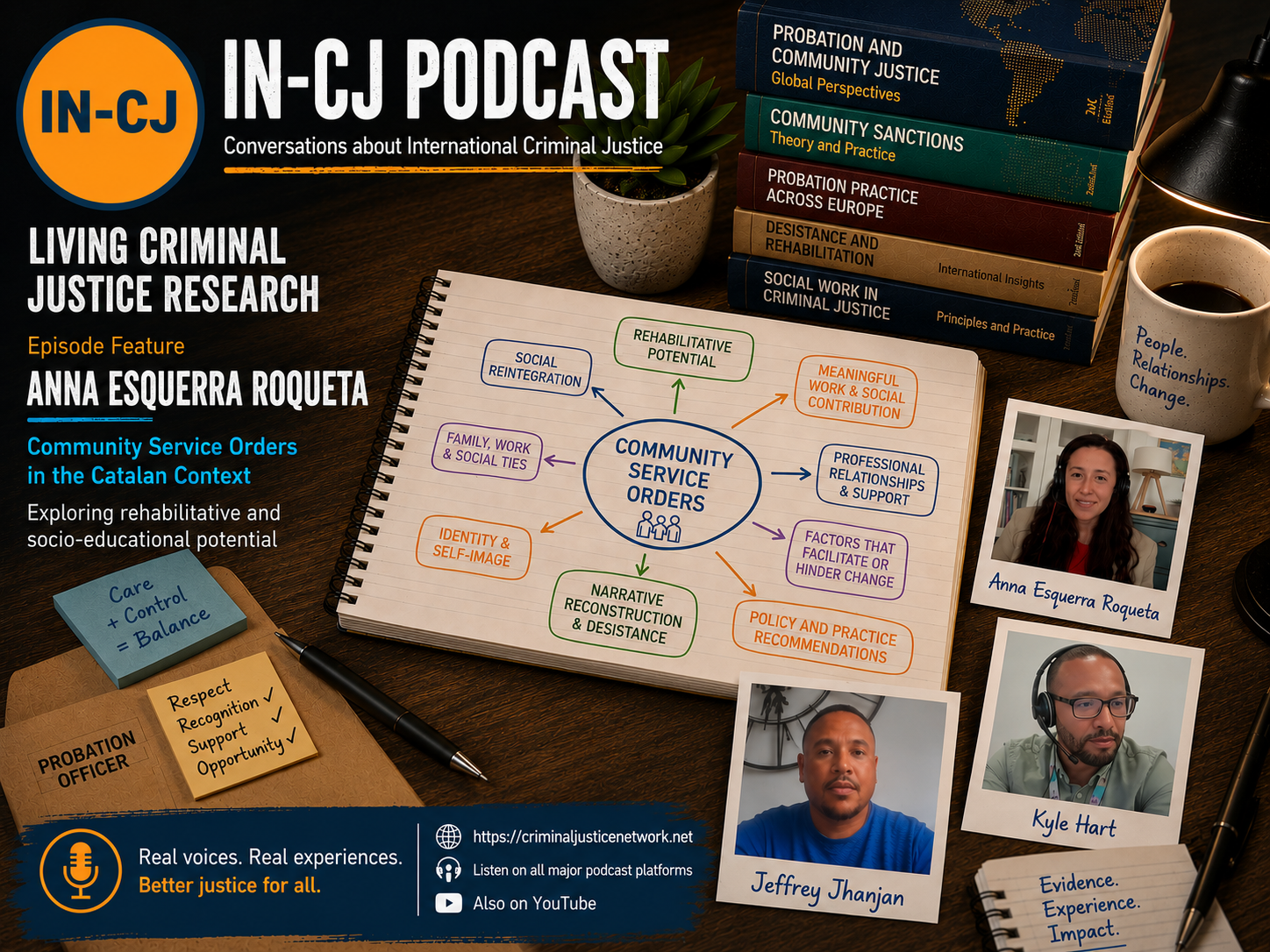
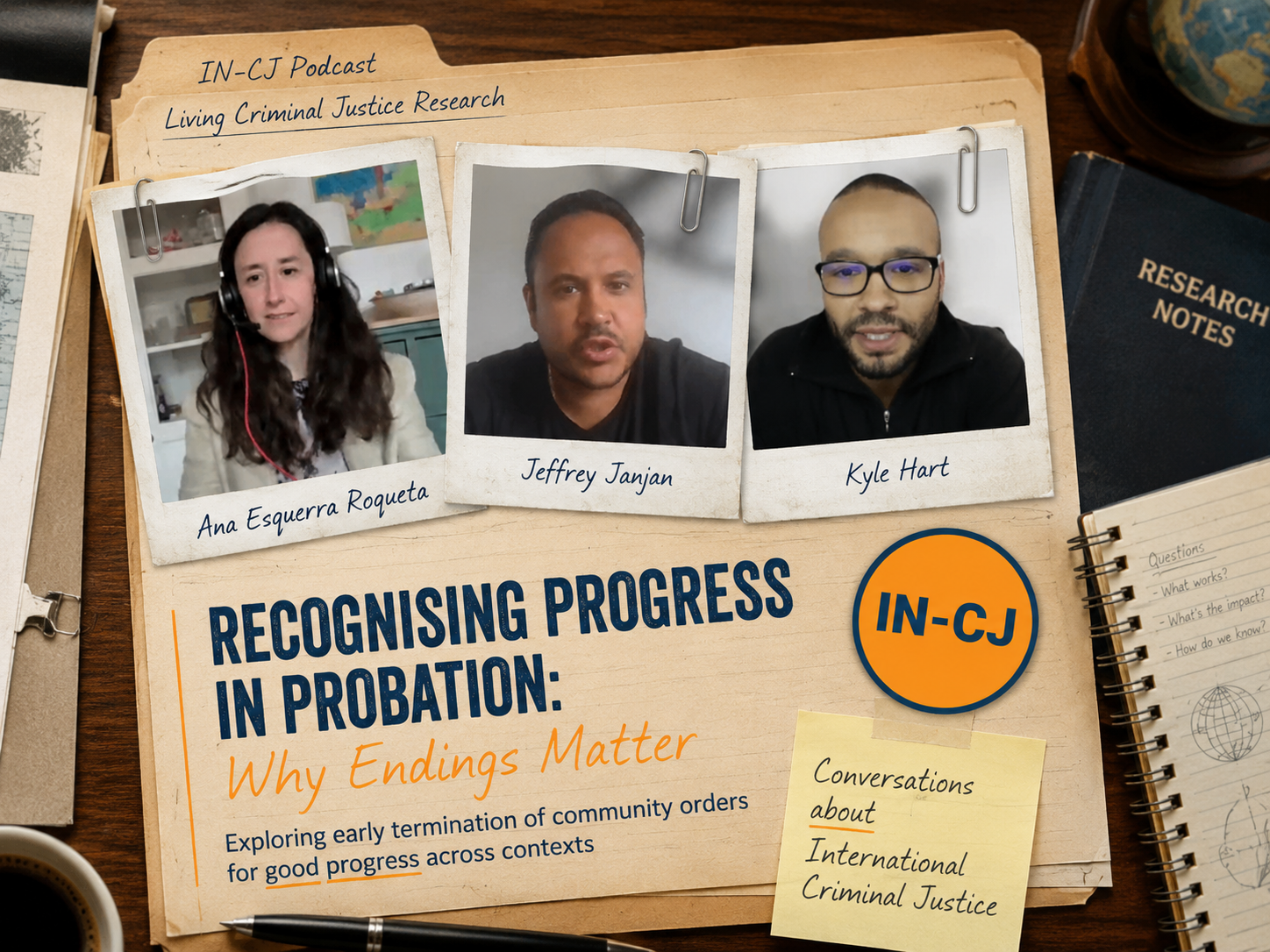
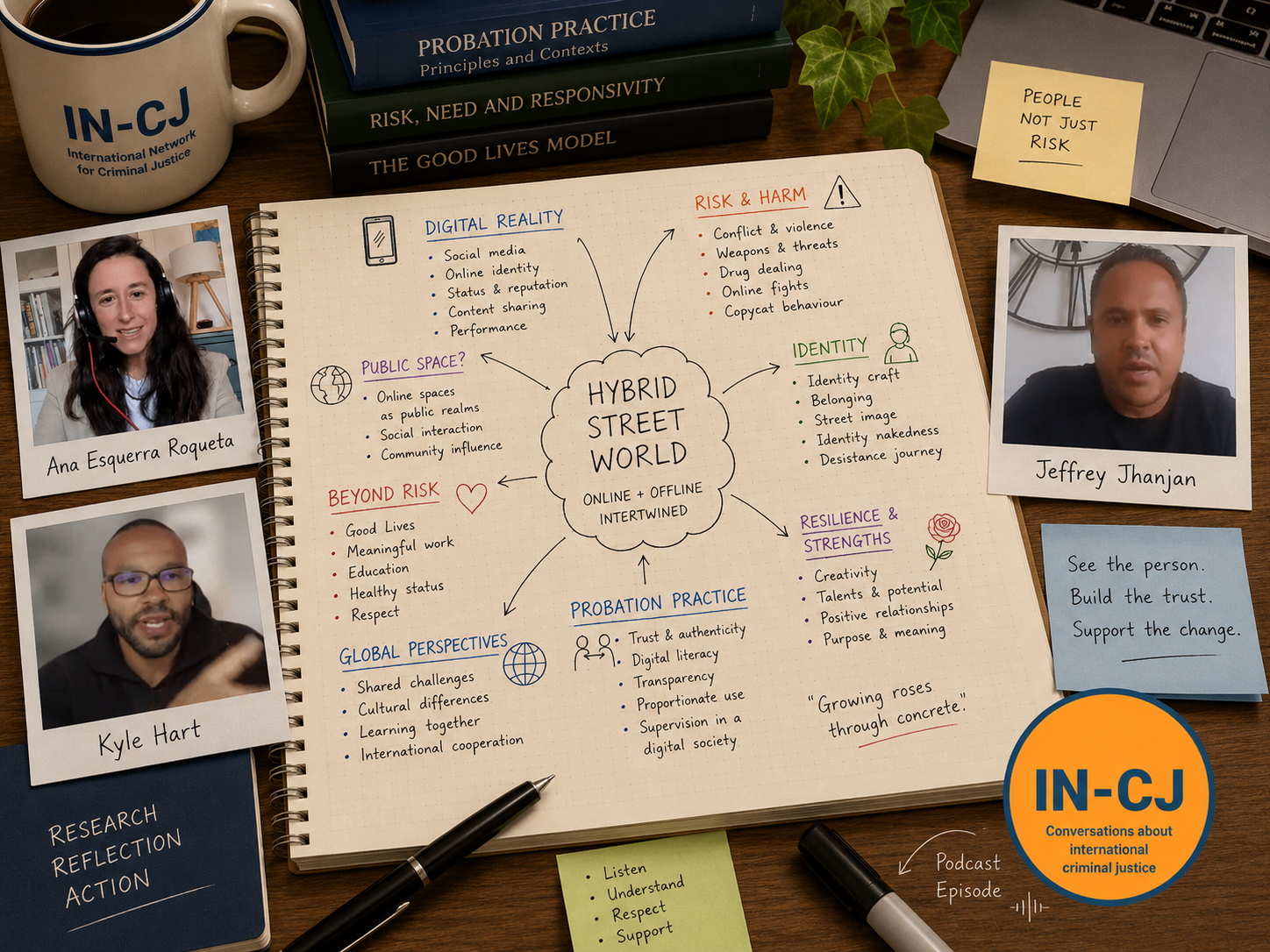
In this episode of the IN-CJ podcast series, Living in Criminal Justice Research, Ana Esquerra Roqueta and Kyle Hart speak with Jeffrey Jhanjan, policy advisor at probation organisation Fivoor in the Netherlands and PhD candidate at Leiden University. The discussion focuses on Jeffrey’s research, Warm Hearts in Cold Streets, Growing Roses Through Concrete, and explores how probation practitioners can better understand the increasingly complex relationship between street culture, social media, risk, identity and resilience.
The central point of the conversation is that many young people involved in probation do not live simply in an offline world or an online world. They move between both, often in ways that are continuous, performative and mutually reinforcing. Jeffrey describes this as a “hybrid street world”, where online identity and offline social life are deeply intertwined. This matters for probation because conflict, status, reputation and risk can now move rapidly between digital platforms and physical settings.
The discussion does not treat street culture as inherently criminal. Jeffrey is careful to stress that street culture can also be a source of creativity, identity formation, belonging and expressive life. The difficulty for probation services is that the same social world may also carry pro-criminal meanings, encourage anti-social thinking, intensify conflict, or provide a stage for the performance of violence, wealth, intimidation and criminal affiliation. For practitioners, this creates a practical challenge. How can probation supervision recognise the reality of online behaviour without reducing young people to what they post?
A recurring concern in the podcast is that probation practice may sometimes be working with only half the picture. A person may present one version of themselves in the probation office, while maintaining a very different identity online. Social media can reveal status claims, threats, affiliations, conflict, humiliation, conspicuous consumption, or what Jeffrey describes in relation to wider academic debate as “performance crime” and “criminal selfies”. These online signals cannot be interpreted crudely, but neither can they be ignored. They may offer insight into attitudes, pressures and risks that are not visible in face-to-face supervision.
This raises an important ethical question. If probation practitioners look at social media activity, does this become a form of surveillance that damages trust? Jeffrey’s answer is measured. He argues that transparency and proportionality are essential. The purpose should not be secret monitoring, but the careful inclusion of online behaviour as a legitimate subject of professional discussion, especially when there is an online element in offending, conflict or risk. In a digital society, asking about social media use, online presentation and digital conflict should not be treated as exceptional. It should be part of a realistic understanding of the person’s life.
Ana Esquerra Roqueta adds an important sociological point by asking whether social media can be understood as a form of public space. This question matters because probation services already pay attention to where people go, who they spend time with, and what situations may place them or others at risk. If digital spaces are also public or semi-public social environments, then they have to be understood as part of the ecology of supervision. The challenge is to do this lawfully, ethically and with sufficient digital literacy.
The episode also asks whether probation is sometimes too focused on risk and not sufficiently attentive to resilience. Jeffrey acknowledges the importance of risk assessment, including established approaches such as the Risk-Need-Responsivity model, but argues that probation must also pay attention to what people need in order to live a good life. This means supporting a more stable identity, meaningful work or education, positive relationships, and legitimate routes to status and respect.
Identity is one of the strongest themes in the conversation. For young people whose standing, belonging and recognition have been built through street identity, desistance is not simply a behavioural adjustment. It may involve the loss of a whole social self. Jeffrey refers to the difficulty of “identity nakedness”, the unsettling question of what remains when someone leaves behind the identity that previously gave them status. This is one reason why purely punitive or compliance-led approaches can miss the point. They may demand change without helping someone to build a viable alternative self.
The discussion is therefore not only about risk management. It is about recognition. Jeffrey argues that probation clients are not defined only by crime. Some have talents in sport, communication, leadership, creativity or public speaking. Some may be able to use their experience to help professionals understand street life more accurately. Probation services, he suggests, must be able to see these capacities, not as sentimental additions to practice, but as part of effective rehabilitation.
The international dimension of the podcast is particularly significant. Kyle Hart asks whether the patterns Jeffrey identifies are specific to the Netherlands or can be seen across borders. Jeffrey notes that while there are national and cultural differences, digital culture enables rapid transmission of styles, conflicts and behaviours. He discusses the spread of drill-related aesthetics and forms of violent symbolic expression, including the online mocking of victims, as examples of harmful copycat behaviour that can travel internationally. Ana adds that in Spain, some gang-related patterns are shaped through links with South America. This makes international knowledge exchange essential. Probation services in one country cannot assume that these phenomena are local, isolated or static.
The conversation also touches on gender. Jeffrey notes that his current research focuses on young men and that the hybrid street world he studies is often highly masculine. However, women may also participate, sometimes in facilitative roles, and this remains an area requiring further research. This is a useful reminder that digital street culture should not be treated as a single uniform phenomenon. It is shaped by gender, place, social history, migration, music, platform culture and local criminal justice responses.
Towards the end of the episode, the discussion turns to authenticity in probation practice. Jeffrey suggests that young people are highly sensitive to whether practitioners are genuine. Probation work is not only technical. It is relational. Practitioners may build trust when they are able to bring something of their own humanity into the work, without losing professional boundaries. The idea of the “wounded healer” is introduced as a way of thinking about why some people are drawn to probation work, and how lived difficulty, properly held, can deepen professional connection rather than undermine it.
This is where the image behind Jeffrey’s research title becomes most resonant. “Growing roses through concrete” captures the central tension of the discussion. The street may be a hard environment, and the online extension of street culture may intensify harm, risk and conflict. Yet even in difficult conditions, there may be resilience, intelligence, creativity and potential. The role of probation is not to romanticise street culture, nor to demonise it. It is to understand it with sufficient accuracy, curiosity and ethical care.
For practitioners, this episode offers a clear challenge. Probation services need better training, clearer guidance and stronger digital literacy. They need to understand how online behaviour relates to identity, risk, belonging and harm. They also need to avoid reducing digital practice to surveillance. The task is to build forms of supervision that are transparent, proportionate, relational and alert to the changing realities of young people’s lives.
As part of the Living in Criminal Justice Research series, this discussion shows how research can open practical questions for probation, policy and professional development. It asks practitioners to look beyond the interview room, beyond the case file, and beyond a narrow view of risk. In doing so, it offers a richer account of how criminal justice practice might respond to the hybrid worlds in which many young people now live.