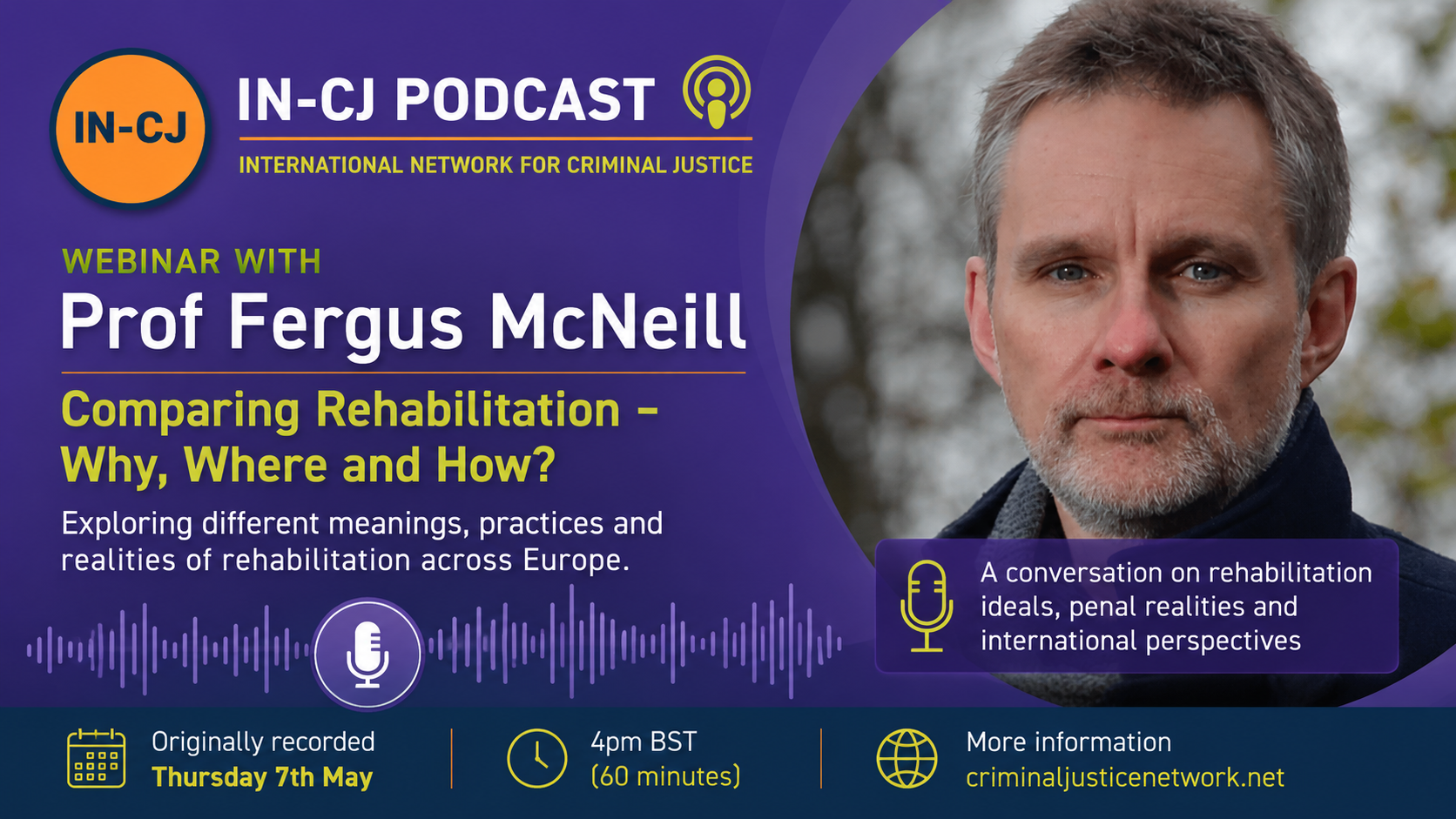
Fergus McNeill Comparing Rehabilitation – Why, Where, And How?
Podcast: Play in new window | Download
Subscribe: Apple Podcasts | Spotify | Amazon Music | TuneIn | RSS
What do we mean when we talk about rehabilitation in criminal justice? Is it a process of changing an individual, a legal restoration of rights, a social return to community, or a broader relational repair between people, institutions and society?
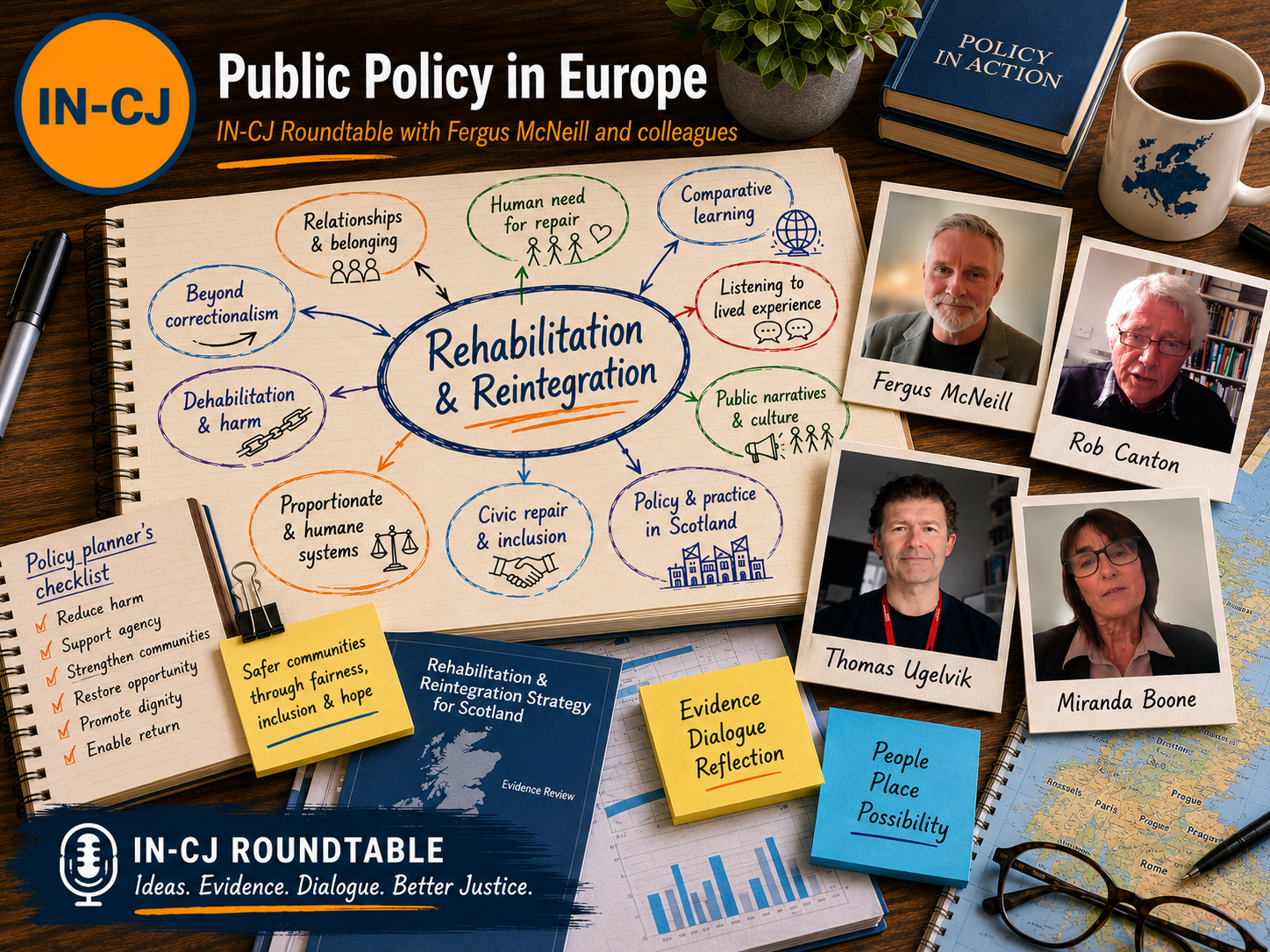
These questions were at the centre of the latest IN-CJ webinar, in which Professor Fergus McNeill, Professor of Criminology and Social Work at the University of Glasgow, introduced the themes behind a major five-year European research project on rehabilitation and reintegration. The project, Rehabilitation and Reintegration in Europe, brings together researchers working across Scotland, Norway and the Netherlands, with a wider ambition to rethink how rehabilitation is understood, practised and evaluated.
Download the Presentation Slides
Professor McNeill’s presentation, Comparing Rehabilitation: Why, Where, and How, began by reminding listeners that rehabilitation is not a simple or settled idea. In some traditions, particularly in Anglophone criminal justice systems, rehabilitation has often been understood as correction, treatment or intervention. In this framing, the focus is placed on changing the attitudes, behaviours, capacities or motivations of the person who has offended.
However, the webinar also explored a broader European understanding of rehabilitation, particularly the idea of social rehabilitation. In this view, rehabilitation is not only about individual change. It is also about a person’s social and legal position, their relationships, their rights, their access to resources, and their ability to belong within a community. This difference matters because it changes the questions we ask. Rather than only asking whether someone has changed, we might also ask whether society, law, policy and practice have made reintegration possible.
A central part of the discussion was the six-part model of rehabilitation developed by Professor McNeill and Alejandro Rubio Arnal. This model identifies personal, legal, moral, social, material and civic-political forms of rehabilitation. Each of these dimensions highlights a different aspect of what it might mean to support reintegration. Personal development, legal restoration, reconciliation, social acceptance, housing and income, political participation and civic belonging all become part of the wider picture.
This broader model challenges the tendency to measure rehabilitation narrowly through reconviction or reoffending rates. While such measures may have a place, they do not fully capture whether someone has secure housing, meaningful relationships, access to income, social recognition, restored rights, or a viable place in civic life. One of the important questions raised in the webinar was therefore how criminal justice systems might develop more adequate ways of understanding success.
The webinar also considered the gap between rehabilitative ideals and penal realities. Professor McNeill drew attention to the ways in which overcrowded prisons, disrupted progression, poor conditions, limited access to education and family contact, and risk-driven regimes can undermine claims that systems are meaningfully rehabilitative. Rehabilitation can be presented as an escape route from cycles of punishment and inequality, but it can also become a dead end when it is reduced to managerial targets, risk control, or the performance of prescribed personal change.
This tension led into the question of why comparative research matters. By comparing Scotland, Norway and the Netherlands, the project aims to examine jurisdictions that are often assumed to have relatively progressive penal traditions. The purpose is not to idealise these systems, but to question them carefully. Comparative research allows each system to see itself differently. It asks what becomes visible when familiar practices are explained to others, and when assumptions are tested across different legal, cultural and institutional contexts.
The research project will examine the rehabilitative ideal, the scale and shape of rehabilitation, the technologies and techniques used to pursue it, and the lived and professional experience of rehabilitation in practice. Importantly, the project will also use creative and dialogical methods, including workshops with people with lived experience, practitioners and justice leaders. Participants will not simply provide data for researchers to interpret. They will help to make sense of the comparisons themselves.
The discussion after the presentation opened several lines of inquiry that may be useful for listeners to consider ahead of the follow-up roundtable. One issue concerned the movement of ideas between countries. How do policies, practices and assumptions travel across borders? Why do some practices flourish in one context but remain marginal in the place where they first emerged?
A second issue concerned the normative question. Should comparative research simply describe different models of rehabilitation, or should it also ask what rehabilitation ought to be? If rehabilitation is tied to dignity, rights and belonging, then it cannot be treated only as a technical matter of intervention design or service delivery.
A third issue concerned measurement. What should count as success in rehabilitation? Is desistance enough? Should quality of life, housing, relationships, legal income, control over addiction, civic participation and social recognition also be treated as core indicators?
A fourth issue concerned the place of Global South and Global East perspectives. The webinar raised the risk that the Global North has too often exported poor correctional ideas and commercialised technologies under the label of rehabilitation. It also raised the possibility that countries and communities with different state capacities may offer important lessons about community justice, citizenship, mutual support and reintegration.
A fifth issue concerned the meaning of social rehabilitation in international law and policy. The discussion suggested that a shift from reducing reoffending to enabling reintegration could support a more balanced and relational policy agenda. If punishment creates or worsens a relational problem between a person and society, then rehabilitation must also be understood as a relational process.
In his closing remarks, Professor McNeill returned to two key concepts: recognition and dialogue. Rehabilitation, he argued, must begin with the recognition of the person as someone with dignity, worth and potential. From there, it must proceed through dialogue between the individual, the state, the community and those involved in support, supervision or intervention. Without recognition and dialogue, rehabilitation risks becoming a monologue imposed by institutions upon people.
The follow-up roundtable on Wednesday 10th June will provide an opportunity to continue these discussions with other members of the research team. Listeners may wish to consider one central question in advance: if rehabilitation is to be legitimate, effective and humane, what relationships must it repair, and who needs to be part of that conversation?