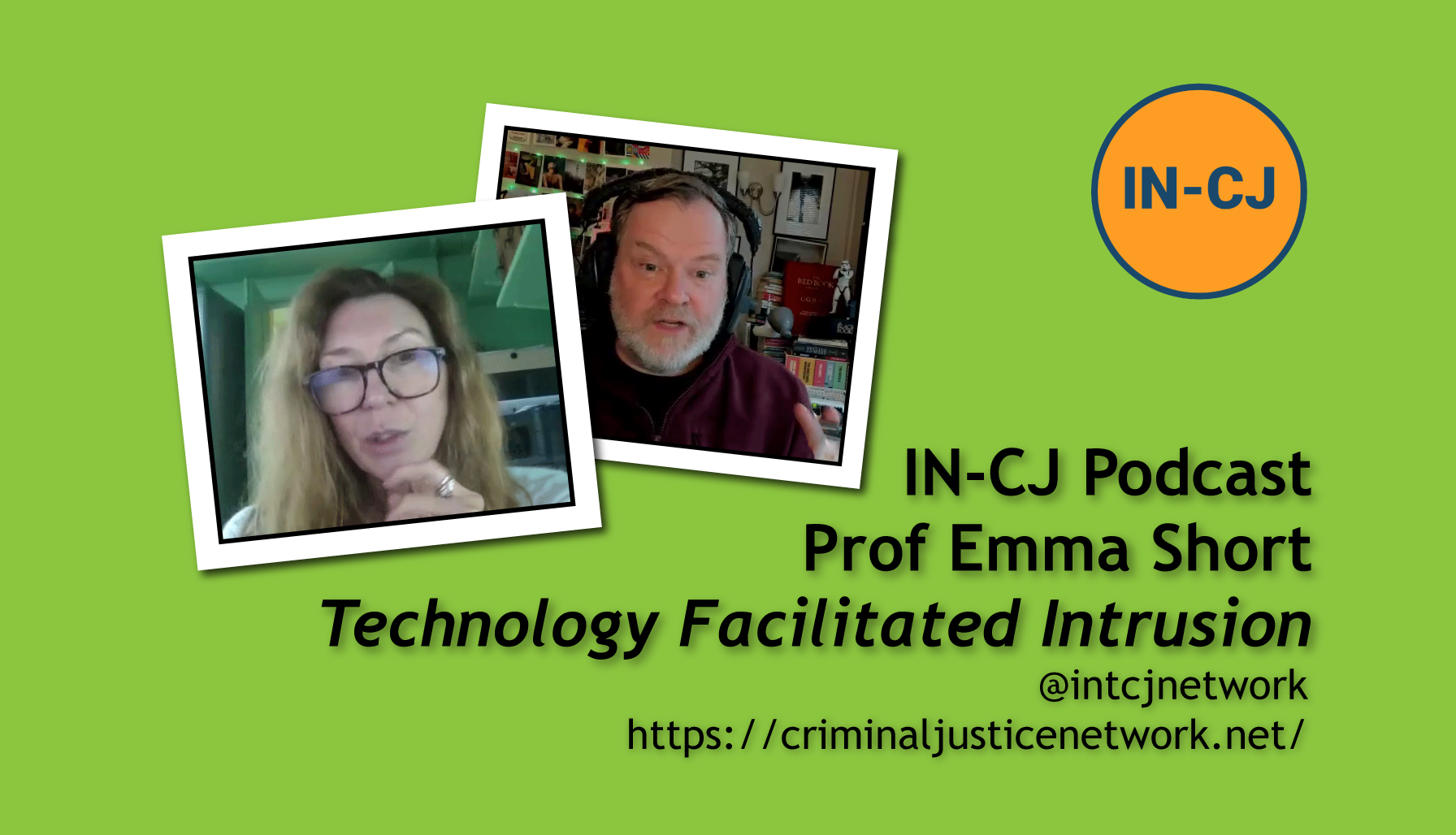
IN-CJ Podcast – Prof Emma Short Technology Facilitated Intrusion
Podcast: Play in new window | Download
Subscribe: Apple Podcasts | Spotify | Amazon Music | TuneIn | RSS
Digital communication has transformed how people relate to one another, how identities are formed, and how harm is experienced. In this episode of the IN-CJ podcast, Rob Watson is joined by Professor Emma Short to explore what happens when everyday online interaction crosses into intrusion, surveillance, and stalking. The conversation sits at the intersection of psychology, technology, and criminal justice, raising questions that current legal and institutional frameworks are still struggling to answer.
Emma Short’s research focuses on what she describes as technology-facilitated intrusion. While the language around cyberstalking, online stalking, and digital harassment remains unsettled, the underlying behaviour is increasingly familiar. Digital platforms reduce friction, expand reach, and collapse social context, allowing actions that once required proximity or effort to be carried out remotely, persistently, and often invisibly. What might begin as observation or curiosity can, under certain conditions, develop into fixation, control, and fear.
A key theme in the discussion is the idea of context collapse. Online communication routinely reaches audiences far beyond those imagined by the person posting. Emotional disclosures intended for a small group can be amplified, recirculated, and stripped of their original meaning. This creates vulnerability not because people are reckless, but because human communication evolved for limited, relational settings rather than global, permanent ones. As Emma Short notes, most people are psychologically ill-equipped to anticipate how their communications will travel or how they may be interpreted.
The podcast also examines where boundaries are drawn. Not all online attention is harmful, and not all unwanted contact constitutes a criminal offence. The distinction lies in patterns of behaviour rather than isolated acts. Stalking involves persistence, fixation on a particular individual, and actions that cause fear, distress, or disruption to daily life. In the digital context, this can include repeated messaging, monitoring through social media, misuse of location-enabled technologies, or sustained attempts to intrude into another person’s personal space.
Importantly, the conversation challenges early narratives that placed responsibility on victims to withdraw from online spaces. Visibility is no longer optional for many people. Participation in professional life, social connection, and even income generation increasingly depends on maintaining an online presence. Advising individuals to disappear from digital platforms in order to avoid harm risks reproducing forms of victim blaming that criminal justice systems have spent decades trying to undo.
The episode situates cyberstalking alongside related but distinct phenomena, including online harassment, hate speech, and trolling. While these issues often overlap in public debate, Emma Short emphasises the importance of analytical clarity. Cyberstalking is not random abuse or general hostility directed at groups. It is interpersonal, targeted, and relational, frequently emerging in the aftermath of relationship breakdowns or perceived grievances. Conflating these behaviours can obscure both the lived experience of victims and the kinds of responses that are most effective.
From a criminal justice perspective, the discussion highlights gaps in consistency and capacity. While policing has developed sophisticated digital expertise in areas such as fraud and terrorism, these skills are not always shared effectively across areas such as stalking and violence against women and girls. Platform governance further complicates matters. Responses from social media companies are uneven, moderation practices fluctuate, and access to data often depends on complex legal processes that frontline officers may not be trained to navigate.
The conversation also touches on broader tensions between freedom of expression and public safety. Digital platforms are spaces for political speech, disagreement, and protest, but they are also environments in which harm can escalate rapidly. Drawing principled, evidence-based distinctions between lawful expression and criminal conduct remains one of the most pressing challenges facing legislators, regulators, and practitioners alike.
Rather than offering simple solutions, the podcast opens space for further inquiry. Emma Short calls for louder, more coordinated conversations about what works, what is missing, and what resources are needed to respond effectively. Comparative perspectives, interdisciplinary research, and shared learning across jurisdictions all have a role to play. As digital communication continues to reshape social life, criminal justice systems will need to adapt not only their tools, but their underlying assumptions about behaviour, responsibility, and harm.
This episode forms part of IN-CJ’s ongoing work to support informed, international dialogue about emerging challenges in criminal justice. It is an invitation to practitioners, researchers, and policymakers to think more carefully about how technology mediates relationships, how harm is experienced, and how systems can respond without retreating into either moral panic or denial.